
AI Alternatives to Movie Magic Scheduling
February 11, 2026 • 11 min read • By Shamel Studio Team
For decades, professional film scheduling has meant one thing: expensive software, steep learning curves, and highly specialized knowledge. Tools like Movie Magic Scheduling became the standard because they were powerful, but that power often came with significant overhead.
Today, filmmaking looks different. Independent productions are expected to operate with the same level of organization as studio projects, often with far fewer resources. At the same time, experienced producers and assistant directors are under pressure to move faster, respond to constant changes, and keep teams aligned without rebuilding schedules from scratch.
This is where modern scheduling tools enter the picture. Many of them use AI, not as a selling point, but as a way to reduce friction, remove repetitive work, and make professional grade scheduling accessible to more filmmakers.
In this article
What Filmmakers Mean by “AI” in Scheduling Software
When filmmakers talk about AI scheduling, they are not asking for software to make creative decisions. They are not looking for a system that replaces schedulers, assistant directors, or producers.
What they want is help with the parts of scheduling that are mechanical, time consuming, and prone to error.
In practical terms, AI in scheduling software is used to automate the tedious parts of the workflow so filmmakers can focus on creative and logistical decisions. That includes things like identifying scenes and elements from a script, reducing manual data entry, and making it easier to adjust schedules when inputs change.
The human remains in control. The technology supports the work rather than dictating it. This distinction is important, especially in an industry where creative judgment and production experience are central to the process.
To see how automation is already reshaping the broader production workflow, read our article on how automation is changing film scheduling and budgeting.
How AI Lowers the Barrier to Entry for Indie Filmmakers
For many independent filmmakers, traditional scheduling tools present a real obstacle. Learning complex software takes time. Hiring specialized crew to manage breakdowns and schedules adds cost. As a result, scheduling is often delayed, simplified, or handled with spreadsheets that do not scale well as a project grows.
AI assisted scheduling tools help lower this barrier.
By automating early steps like script breakdown and initial schedule generation, these tools allow small teams to get to a workable schedule much faster. Filmmakers can see how a script translates into a production plan without needing years of experience with legacy software.
This does not mean lowering professional standards. It means giving indie filmmakers access to the same level of structure and clarity that larger productions have, without requiring the same overhead. A director or producer can spend less time wrestling with logistics and more time refining the creative and practical decisions that matter.
In short, AI makes professional workflows more accessible without making them less rigorous.
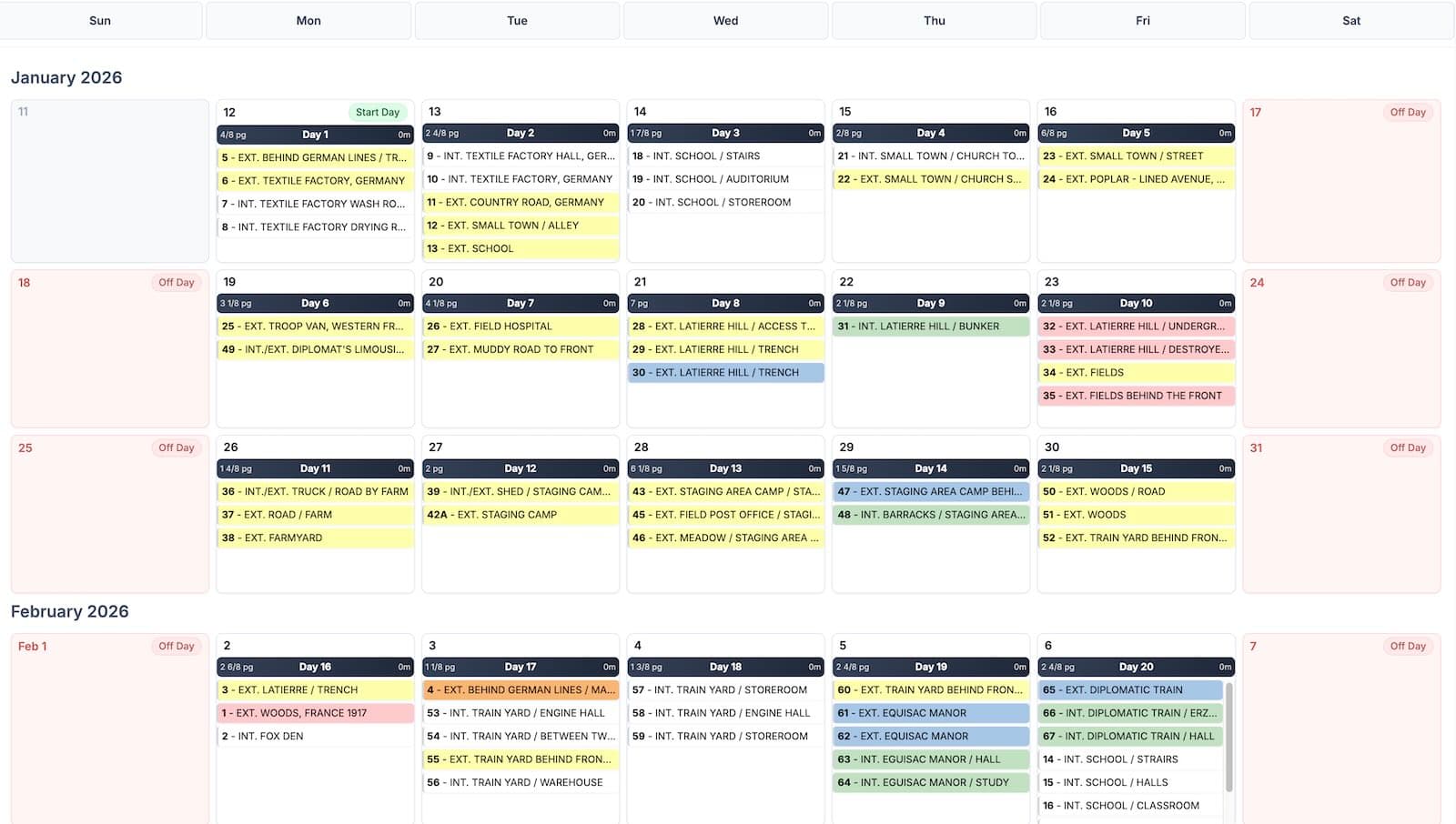
Calendar view for production scheduling
How AI Improves Productivity for Working Professionals
For experienced producers, line producers, and assistant directors, the value of AI is not about learning something new. It is about removing friction from workflows they already understand.
Traditional scheduling often involves repeating the same tasks across projects. Data is entered manually, adjusted manually, and rechecked manually. When scripts change, which they always do, schedules can require extensive rework.
AI assisted tools reduce this repetition. They help teams move from script to schedule faster, handle revisions more gracefully, and avoid errors caused by re-entering the same information in multiple places. The result is not a loss of control, but a gain in efficiency.
For professionals working under real production pressure, this means more time spent making informed decisions and less time spent maintaining the mechanics of the schedule. The workflow becomes more responsive, which is critical on modern productions where change is constant.
Where AI Actually Helps in Film Scheduling, Practically
The value of AI in scheduling becomes clear when it is applied to very specific pain points that filmmakers deal with every day. This is not about abstract intelligence. It is about removing friction from workflows that have historically been manual and fragile.
One of the most immediate benefits is script understanding. Instead of manually tagging every scene, character, location, and element, AI assisted tools can identify and organize this information automatically. Filmmakers can then review and adjust as needed, rather than starting from a blank slate.
Another major advantage is handling change. Script revisions are inevitable. In traditional workflows, even small changes can require rebuilding large parts of a schedule. AI assisted systems are better equipped to adapt, allowing schedules to update intelligently without forcing teams to redo work they have already completed.
AI also helps reduce duplicate data entry. When information flows cleanly from script to schedule and into other production planning tools, teams spend less time copying and reconciling data. This leads to fewer errors and a clearer picture of how a production is actually coming together.
These improvements may seem incremental on their own, but together they significantly reduce the time and effort required to maintain a reliable schedule.
AI suggestions in action: automatically identifying elements from your script
Why These Capabilities Are Often Compared to Movie Magic
Movie Magic Scheduling remains the reference point for professional film scheduling. It has been the standard for a long time, and many production workflows are still built around it.
When filmmakers search for AI alternatives, they are not necessarily rejecting Movie Magic outright. They are using it as a benchmark. The comparison exists because Movie Magic represents a traditional approach that assumes static inputs, heavy manual setup, and limited flexibility once a schedule is in motion.
Modern tools are often measured against it because they aim to solve problems that legacy software was not designed to address. Faster iteration, easier revisions, and reduced setup time are not optional features anymore. They are expectations shaped by how productions operate today.
Where Shamel Studio Fits: Modern Scheduling Without Losing Control
Shamel Studio was built with this shift in mind. It is designed to feel familiar to filmmakers who have used traditional scheduling tools, while removing many of the friction points that slow productions down.
AI is used intentionally and quietly. It helps automate repetitive tasks, accelerate early planning, and make revisions easier to manage. It does not make creative decisions or obscure how schedules are built. Filmmakers remain in control at every step.
This approach allows Shamel Studio to serve both independent filmmakers and experienced professionals. Indie teams can access professional grade scheduling without a steep learning curve. Established producers and assistant directors can move faster without sacrificing accuracy or control.
The goal is not to reinvent scheduling for the sake of novelty. It is to make it work better for how films are actually made today.
If you are interested in how Shamel integrates with annotation tools you already use, learn how the Shamel Studio and Scriptation integration lets you go from script notes to a complete breakdown in seconds.
What to Look for When Choosing a Modern Scheduling Tool
Regardless of how a tool is labeled, there are a few key questions filmmakers should ask when evaluating modern scheduling software:
- Speed: How quickly can you go from script to a usable schedule?
- Adaptability: How easily can the schedule adapt when the script changes?
- Transparency: How transparent is the system in showing how decisions are made?
- Collaboration: How well does it support collaboration across departments?
- Interoperability: How smoothly can information be exported and shared with the rest of the production?
Tools that perform well in these areas tend to reduce stress, save time, and support better decision making throughout the production process. For a deeper dive into scheduling fundamentals, our step-by-step shooting schedule guide walks through the entire process from breakdown to final schedule.
Professional Results Without the Professional Overhead
AI in film scheduling is not about replacing people or redefining creativity. It is about removing unnecessary obstacles that slow productions down.
For independent filmmakers, this means access to workflows that were once difficult to reach. For working professionals, it means less time spent maintaining schedules and more time spent guiding productions forward.
In the end, labels matter far less than outcomes. The best scheduling tools are the ones that let filmmakers focus on what they do best, while quietly handling the repetitive work that pulls time away from the creative process.
If you are exploring modern alternatives to legacy scheduling workflows, Shamel Studio is built to support that transition, thoughtfully and practically.
See how AI simplifies your scheduling workflow
Upload a script and watch AI handle the breakdown automatically. Try Shamel Studio's AI-powered scheduling to experience the difference firsthand.
Frequently Asked Questions
What does AI actually do in film scheduling software?
AI in film scheduling automates repetitive tasks like identifying scenes, characters, locations, and props from a script. It reduces manual data entry, helps handle script revisions more efficiently, and allows schedulers to focus on creative and logistical decisions rather than mechanical work.
How does AI handle script revisions differently than traditional scheduling software?
AI-assisted tools detect what changed between script versions, update element associations automatically, and preserve valid scheduling decisions — reducing rework during revision cycles.
Can indie filmmakers use AI scheduling tools without professional training?
Yes. One of the key benefits of AI assisted scheduling is that it lowers the barrier to entry. Tools like Shamel Studio are designed to be intuitive, allowing independent filmmakers to create professional grade schedules without years of experience with legacy software.
Does AI in scheduling replace the role of assistant directors or producers?
No. AI handles the mechanical and repetitive parts of the scheduling process. Creative judgment, production experience, and decision-making remain entirely in the hands of the filmmaker. AI supports the work rather than dictating it.
Can AI scheduling tools work across multiple scripts for TV series?
Yes, AI tools like Shamel Studio manage multiple scripts within a project, identifying recurring elements and cast patterns across episodes.