
What Is a Film Recoupment Waterfall?
A practical guide to film financing waterfalls, payment priority, recoupment, and how to model your own deal.
• 9 min read • By Shamel Studio Team
If you have spent any time around film finance, you have probably heard terms like film recoupment waterfall, film financing waterfall, or revenue waterfall.
They all point to the same basic idea: when a film starts generating revenue, who gets paid, in what order, and how much? That order matters because two films can generate the same revenue and still produce very different outcomes for investors, producers, and other participants depending on how the deal is structured.
For producers, a waterfall helps you structure deals more clearly and communicate expectations. For investors, it helps answer the question that matters most: How do I get my money back, and what happens after that? Industry professionals consistently frame the waterfall as one of the core concepts in film finance for exactly that reason.
In this guide, we will break down what a film recoupment waterfall is, how it usually works, what "recoupment" actually means, and how to model your own structure using a film recoupment waterfall calculator.
Table of Contents
What Is a Film Recoupment Waterfall?
A film recoupment waterfall is the payout schedule that determines how revenue from a film is distributed among the parties with a financial interest in the project. Revenue comes in at the top, then flows through a series of contractual payment tiers until the money runs out or all tiers have been satisfied. That is why it is called a "waterfall."
You may also see this referred to as:
- film financing waterfall
- film revenue waterfall
- investor waterfall
- recoupment schedule
The wording changes, but the purpose is the same: it defines payment priority.
What Does "Recoupment" Mean in Film?
In film finance, recoupment simply means getting money back. Most often, it refers to the process of returning capital to the people or entities that put money into the film before profits are split more broadly.
That could include:
- a distributor recouping fees or expenses
- a lender recouping principal and interest
- an investor recouping their original investment
- an investor receiving a preferred return before profit participation begins
This is one reason filmmakers and investors can talk past each other. One person may hear "the movie made money" and think "great, everyone got paid." But in practice, whether anyone actually sees meaningful cash depends on where they sit in the waterfall.
How a Film Financing Waterfall Usually Works
There is no single universal waterfall. The exact order is negotiated and can vary from project to project. But most industry discussions follow a similar logic: money enters at the top, then gets allocated through a set of priority layers.
A simplified version often looks like this:
1. Gross Receipts Come In
This is the top of the waterfall: theatrical revenue, streaming licenses, TV deals, VOD, international sales, and other exploitation revenues. Different windows or territories can have different economics even though the general waterfall logic stays the same.
2. Off-the-Top Deductions and Fees
Before equity investors or producers see anything, there may be deductions such as collection expenses, distributor fees, sales agent commissions, residual obligations, and marketing or delivery costs.
3. Debt and Other Senior Obligations Are Repaid
If the project used loans, bridge financing, tax credit financing, or similar instruments, those obligations are often positioned ahead of pure equity in the waterfall.
4. Equity Investors Recoup Their Capital
This is the point where investors begin getting back their original investment. Depending on the deal, they may recoup just principal or principal plus a preferred return. Many industry examples use structures where the investor receives 100% to 120% of principal before the next split begins, though real deals vary.
5. Deferred Compensation Gets Paid
Some films include deferred fees for producers, cast, crew, or other participants. These may sit above or below investor recoupment depending on the agreement.
6. Remaining Profits Are Split
Once the priority tiers are satisfied, any remaining net profits can be split among investors, producers, talent participants, and other backend participants according to negotiated percentages.
A Simple Film Waterfall Example
Let's say a film raises $1,000,000 in equity.
The deal says:
- investors recoup 100% of principal
- then receive a 20% preferred return
- then remaining profits are split 50/50 between the investor pool and producer pool
Now imagine the film ultimately generates enough revenue, after fees and prior deductions, to leave $2,000,000 available for this section of the waterfall.
Here is what happens:
- The first $1,000,000 goes to repay investor principal
- The next $200,000 goes to satisfy the 20% preferred return
- That leaves $800,000
- The remaining $800,000 is split 50/50
- Investors receive $400,000 and the producer side receives $400,000
That means the investors got back $1.6M total on a $1M investment in this simplified example.
This kind of example is common in film finance education because it makes the structure easy to visualize. The challenge, of course, is that real projects rarely stay this clean. Once you add multiple investors, custom participation points, fees, and multiple revenue scenarios, spreadsheets get messy quickly. That is why most producers eventually move to a dedicated waterfall template or calculator instead of trying to manage the math by hand.
Why Waterfalls Matter So Much in Film Finance
A film financing waterfall is not just an accounting detail. It affects how attractive your deal looks, how clearly you can pitch investors, and how many disputes you may face later.
A good waterfall helps with:
Investor Clarity
Investors want to know where they sit, what gets paid ahead of them, whether they have a premium or preferred return, and when they participate in upside. The waterfall is one of the core tools for making that answer concrete.
Producer Credibility
If you are raising money without being able to clearly explain recoupment, it becomes harder to build trust. A clear path to recoupment is essential when pitching private equity or outside investors. Pairing it with a realistic film budget makes your pitch land even harder.
Better Negotiations
Waterfalls are negotiated structures. Priority positions, preferred returns, deferments, tax credit treatment, and other terms can all move the economics significantly.
Fewer Misunderstandings Later
The more ambiguous the payout structure, the easier it is for conflict to show up once revenue starts arriving. Transparency is one of the recurring themes in modern film finance tools.
Common Terms in a Film Recoupment Waterfall
Here are some of the most common building blocks:
- Gross receipts: All incoming revenue from exploitation of the film. This can include theatrical, streaming, TV, VOD, and other ancillary streams.
- Distribution fee: The distributor's commission, often taken before producers see overages.
- Sales agent commission: A percentage paid to the sales agent for licensing or selling the film.
- P&A / marketing: Prints, advertising, marketing, and delivery costs that may be recouped before other participants share in profits.
- Preferred return: A premium paid to investors before broader profit sharing starts.
- Profit participation: The percentage-based share of profits allocated after the earlier tiers have been satisfied.
Why a Film Waterfall Calculator Is Useful
The problem with waterfalls is not understanding the idea. The problem is modeling the math clearly enough to make decisions.
On paper, a waterfall sounds simple. In practice, most films involve multiple deductions, negotiation points, and scenario planning. You may want to see:
- what happens in a conservative revenue case
- what happens in a base case
- what happens in an upside case
- how a higher preferred return changes investor outcomes
- how profit splits affect the producer pool
- whether the film crosses into meaningful backend at all
That is exactly where a calculator becomes useful.
Our Film Recoupment Waterfall Calculator is built to help you model how revenue flows from gross receipts through fees, recoupment, preferred return, and profit participation. It lets you test multiple revenue scenarios and see how different structures affect each participant. The calculator specifically supports modeling distribution fees, P&A and marketing, sales agent commissions, loan repayment, deferred compensation, equity recoupment, preferred return, and profit splits across conservative, base, and upside scenarios. It also exports a clean PDF waterfall report you can share with investors.
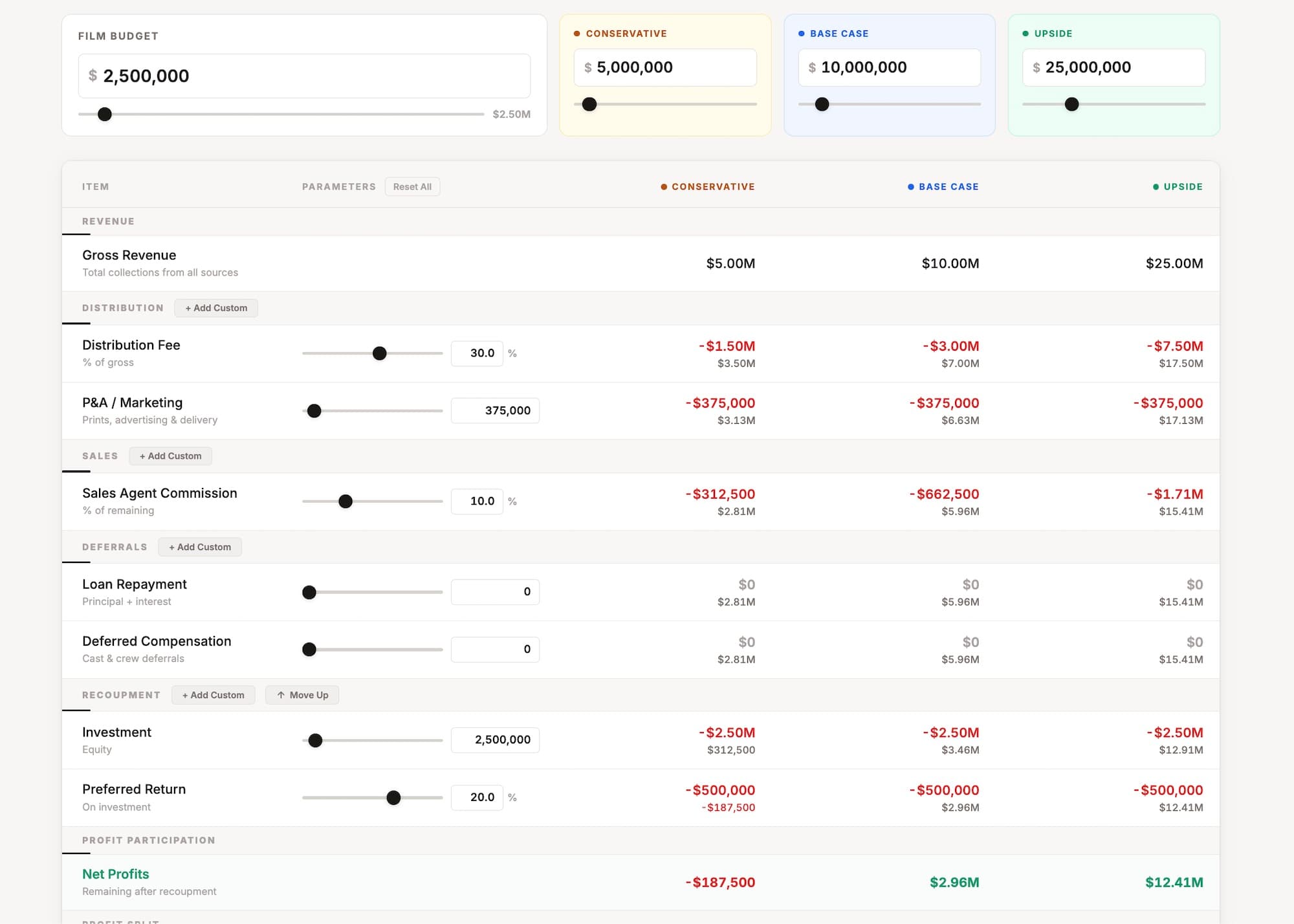
Modeling conservative, base case, and upside scenarios in the Shamel Studio film waterfall calculator
When to Use a Film Financing Waterfall Calculator
A calculator can be helpful if you are:
- preparing investor materials
- comparing financing structures
- pressure-testing a deal before closing
- trying to understand whether backend points are likely to have real value
- evaluating how much revenue it takes before participants below the top tiers get paid
- turning a confusing spreadsheet into a more understandable model
Even if your final legal structure ends up being more detailed, modeling the logic early can save a lot of time. It also pairs naturally with the rest of your prep work, once you have a realistic film budget and a workable shooting schedule, the waterfall is what translates those numbers into a story your investors can actually follow.
Final Thoughts
A film recoupment waterfall is one of the most important concepts in film finance because it determines what revenue actually means for each stakeholder. It is the difference between "the film generated money" and "this specific participant got paid."
If you are producing, raising equity, or evaluating a deal, you do not just need a definition. You need to be able to model the flow. Instead of trying to map the waterfall manually in a spreadsheet, you can plug in your assumptions and see how the structure plays out across different revenue outcomes, then export a polished PDF report to share with your investors.
Frequently Asked Questions
What is a film recoupment waterfall?
A film recoupment waterfall is the payout schedule that defines how revenue from a film is distributed among the parties with a financial interest in the project. Revenue enters at the top and flows through a series of contractual payment tiers, including distribution fees, debt, equity recoupment, preferred return, and profit participation, until the money runs out or all tiers are satisfied.
What does recoupment mean in film?
In film finance, recoupment means getting money back. Most often it refers to returning capital to the people or entities that put money into the film. That includes distributors recouping fees, lenders recouping principal and interest, or equity investors recouping their original investment before broader profit splits begin.
What is a preferred return in a film waterfall?
A preferred return is an additional percentage paid to investors on top of their original investment before profits are split with producers. For example, a 20% preferred return on a $1M investment means investors recoup $1.2M before any net profit distribution begins.
How do you calculate movie profit using a waterfall?
Start with gross receipts, then subtract distribution fees, P&A and marketing, sales agent commissions, debt repayment, and deferrals. Once equity investors recoup principal and any preferred return, the remaining amount is net profit. That net profit is then split between an investor pool and a producer pool based on negotiated percentages. The Shamel Studio film waterfall calculator automates each layer so you can model multiple revenue scenarios instantly.
Why does the order of payments in a waterfall matter?
Because two films can generate identical revenue and still produce very different outcomes for each participant depending on payment priority. A participant sitting above equity recoupment may get paid even on a small return, while a participant below it may receive nothing unless the film significantly outperforms expectations.