Film Tax Incentives Explained: A Producer's Guide to Choosing the Right State
A practical guide to how film production tax incentives work, what the headline rate does not tell you, and the factors experienced producers actually weigh when picking a state.
• 12 min read • By Shamel Studio Team
Where you shoot is the first financing decision. Every other decision, from cast and crew to schedule and post, compounds on it.
U.S. film and television production incentives return between 15% and 45% of qualified spend to producers, and as of 2026, 39 states plus D.C. and Puerto Rico run active programs. For independent producers, that credit or rebate often means the difference between a film that closes financing and one that stalls in development. For studio productions, it determines which state gets the economic activity and which one loses it.
But choosing a state based on its headline percentage is one of the most common and most expensive mistakes in production finance. A 30% refundable credit in a state with a deep crew base, no annual cap, and a fast payout timeline is worth materially more than a 40% transferable credit in a state where the program exhausted its allocation in the first quarter and the broker market discounts credits at twelve cents on the dollar.
This guide breaks down how film tax incentives actually work, what experienced producers weigh beyond the rate, and what the current landscape looks like heading into the second half of 2026.
Table of Contents
What Are Film Tax Incentives?
A film tax incentive is a financial benefit offered by a state or territory to attract film, television, and commercial production. The idea is straightforward: the state gives back a percentage of what a production spends locally, and in return, the production brings jobs, vendor revenue, and economic activity that would otherwise go to a competing state.
The mechanics vary widely. Some programs issue a direct check. Others issue a tax credit you can apply against your own state tax liability or sell to a third party. Some are capped at a fixed annual pool. Others are uncapped but subject to legislative reauthorization. The details matter more than most producers realize until they are deep into prep and discover the money they planned around is not available on the timeline they assumed.
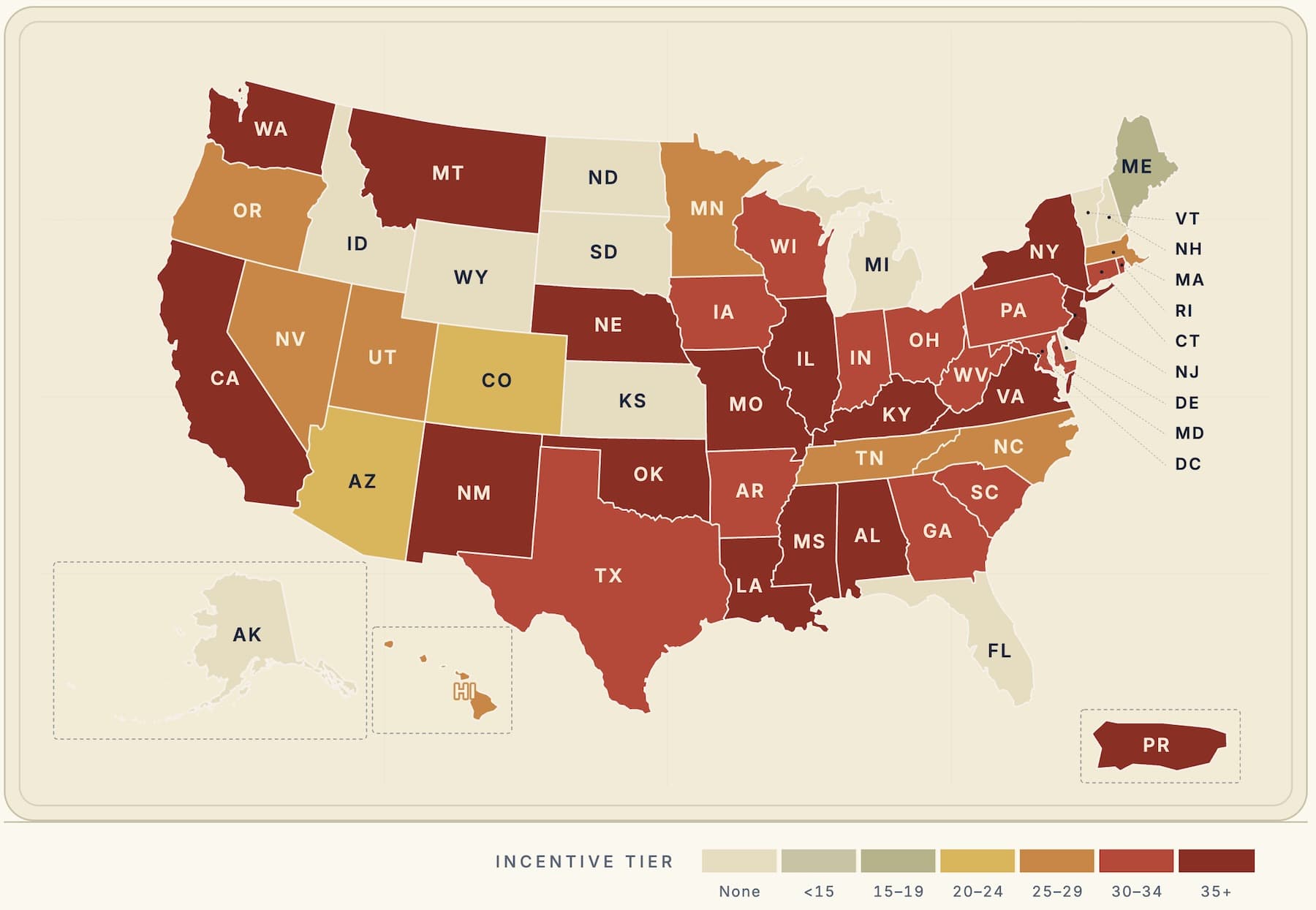
For a full breakdown of every active program, caps, minimum spends, and payroll fringe rates by state, see our interactive Film Tax Incentives Map later in this guide.

Why the Headline Rate Is Only Part of the Story
When you see a state advertise a "30% tax credit," that number tells you the theoretical maximum return on qualifying spend. It does not tell you six things that are often more important to the actual economics of your production:
- How quickly you get paid. A refundable credit that converts to cash within 90 days has a very different net present value than a transferable credit that takes six months to broker and closes at 87 cents on the dollar.
- Whether the program has money left. A $750 million annual cap in California is a fundamentally different proposition than a $4 million pilot program in Iowa. If the cap is exhausted before your application is approved, your effective rate is zero.
- What counts as "qualified spend." Some states exclude above-the-line costs. Others cap per-employee compensation. Others exclude specific categories like insurance or completion bonds. Two states with the same headline rate can produce very different effective rates depending on your budget mix.
- What the fringe environment looks like. Payroll burden, including payroll taxes, union pension and health contributions, and workers' compensation, typically adds 22% to 34% on top of gross wages depending on the state. That spread can dwarf a 5% difference in credit rate.
- Whether there is local crew. If you are flying in department heads and key crew from Los Angeles or New York, the travel, per diem, and housing costs eat into whatever you gained from the incentive. States with deep crew bases (Georgia, New York, California, Louisiana, Illinois, New Mexico) are the ones where the effective rate stays close to the headline rate.
- Whether the program will exist next year. Some incentive programs are permanent statutes. Others are pilot programs or subject to annual reauthorization. If you are planning a multi-season series, the program's legislative stability matters as much as this year's rate.
Five Types of Incentive Programs
Every U.S. program falls into one of five categories. The type determines how quickly you turn the incentive into cash and how much friction is involved.
1. Refundable Tax Credit
The state cuts a check regardless of whether the production company owes state tax. This is the gold standard for producers because it converts directly to cash, usually within months of filing. States like California, New York, Ohio, Kentucky, New Mexico, Hawaii, Maryland, Virginia, and Alabama use this model.
2. Transferable Tax Credit
The credit can be sold to a third-party taxpayer (typically a bank or insurance company) through a broker. The broker takes a spread, so you realize less than face value. Georgia, Massachusetts, Illinois, Pennsylvania, New Jersey, Connecticut, Montana, Puerto Rico, and West Virginia offer transferable credits. Georgia's program is notably uncapped with an active broker market that typically clears at 88 to 90 cents on the dollar.
3. Non-Transferable Tax Credit
Applies only against the production company's own state tax liability. Single-project LLCs rarely have enough state tax liability to use these, which limits their practical value. Louisiana, Indiana, and Missouri use this structure.
4. Cash Rebate
A direct cash disbursement from a dedicated fund. Not technically a tax credit, which simplifies the mechanics. Iowa, Mississippi, South Carolina, Arkansas, Oregon, Oklahoma, Washington, and Wyoming use rebate models.
5. Grant Program
Funded through a specific agency appropriation and allocated competitively. Applications are scored on economic impact, creative merit, or workforce development criteria. Texas, Tennessee, and North Carolina operate grant-style programs.
The Factors That Actually Drive the Decision
Experienced producers and line producers do not pick a state by sorting a spreadsheet column by headline rate. The decision is multidimensional. Here are the factors that matter most in practice:
1. Effective Rate vs. Headline Rate
Stack every applicable uplift (resident labor bonuses, rural location bonuses, qualified-facility bonuses, promotional logo bonuses), then discount for broker fees (if transferable), timing (if the payout takes a year), and any costs that do not qualify. The number you get is the effective rate, and it is the only number that belongs in your budget.
2. Annual Cap and Program Availability
A program's annual cap determines whether your production actually gets an allocation. California's recently expanded $750 million annual pool means most qualifying projects get funded. Georgia's uncapped program means there is no allocation risk at all. But a state like Iowa, with a $4 million annual cap, can only support a handful of productions per year. Always check whether the current fiscal year's cap has remaining availability before committing to a state.
3. Minimum Spend Threshold
Every program has a floor. California requires $1 million in qualified spend. Georgia requires $500,000, which can be aggregated across multiple projects. Wyoming requires $100,000. If your budget sits near the threshold, small scope changes during production can push you below it and disqualify the entire credit.
4. Crew Depth and Infrastructure
This is the hidden variable that separates a good deal on paper from a good deal in practice. Georgia's IATSE Local 479 is one of the largest in the country, with deep bench strength across all departments. New York's crew base is the deepest on the East Coast. New Mexico's Local 480 has grown significantly over the past decade. If you are considering a state where you need to bring in most of your key crew, budget the true cost of travel, per diem, and housing, then recalculate the effective rate.
5. Payroll Burden and Workers' Compensation
Fringe rates vary significantly by state and can shift the economics more than a few percentage points of credit rate. A state with 23% payroll burden and 2.7% workers' compensation creates a very different cost structure than one with 30% burden and 6% workers' comp. These numbers belong in your budget from day one, not as an afterthought in post-production accounting.
6. Payout Timeline and Liquidity
For independent producers using the incentive as part of their financing stack, the timing of when you actually receive the money matters enormously. A refundable credit that pays out 60 days after filing is functionally cash in your production account. A transferable credit that takes six months to broker and close is debt you are carrying. If you are financing against the credit (which many indie producers do), the discount rate and the bridge loan interest are real costs that reduce your effective return.
7. Stackable Uplifts
Many states offer bonus percentages on top of the base rate for specific conditions: hiring local residents, shooting in underserved or rural areas, using qualified production facilities, including a state promotional logo, or meeting diversity hiring targets. These uplifts can add 5% to 15% on top of the base rate and are often the difference between a competitive program and an exceptional one. Illinois, for example, can reach an effective rate of 55% with the right uplift combination. Washington's rebate can stack to 45% across resident payroll, local spend, non-resident below-the-line labor, and rural county bonuses.
Where the Money Is in 2026
The 2026 landscape has shifted meaningfully from even two years ago. Several states expanded their programs, a few new ones launched, and the federal Section 181 deduction officially sunset as of January 1, 2026, making state-level incentives even more important to production financing.
The Major Programs
California expanded its Film and Television Tax Credit Program to $750 million annually for the next five years, up from $330 million. The refundable credit runs from 20% to 35% base, with up to 45% for relocating TV series. Since the expansion, 147 productions have been awarded credits, generating over $5.5 billion in total economic activity. The $54 million per-project cap and $1 million minimum spend still apply.
New York raised its annual cap to $800 million, removed restrictions on above-the-line costs, and made credits available in the year they are earned rather than requiring a waiting period. The program runs through 2034 with a possible extension to 2036. At 30% base with a 10% upstate bonus, this is one of the most aggressive programs in the country.
Georgia continues to operate the only major uncapped program in the U.S. The 20% base credit plus 10% logo placement uplift, combined with no annual cap and no sunset clause, has built the largest stage footprint and deepest crew base in the Southeast. Credits are transferable and the broker market remains active.
New Jersey extended its program through 2049 and increased allowable credits to 40% for in-state studio partners, making it the highest potential rate on the East Coast. Netflix broke ground on a new production facility in the state, signaling long-term confidence in the program's stability.
Illinois signed Senate Bill 1911 into law, extending its program through 2038 and increasing credits for in-state labor and vendor spending up to 35%. Combined with existing uplifts for economically disadvantaged areas and qualifying counties, the effective rate can reach 55%.
Emerging and Expanding Programs
Texas boosted its stackable incentives with new bonus criteria for post-production and crew payrolls, pushing effective grant rates up to 31% for qualifying productions starting September 2026.
New Mexico increased its annual funding cap to $130 million and remains one of the most popular locations for its combination of generous incentives, diverse geography, and growing local crew base.
Wisconsin reestablished its Film Office and launched a $5 million annual credit program as of January 2026, with a 30% credit on resident labor and local spend and a $1 million per-project cap.
Iowa launched a tightly controlled two-year pilot program offering a 30% cash rebate capped at $4 million annually, with a $500,000 minimum in-state spend. Limited capacity, but a meaningful signal of the state's intent to attract production.
Florida introduced a five-year initiative focused on Orange County, committing $25 million over five years with up to a 20% rebate on qualifying local expenditures.
What Changed Recently and Why It Matters
Section 181 Is Gone
As of January 1, 2026, IRC Section 181, the federal provision that allowed immediate expensing of production costs, has officially sunset for all productions that did not commence principal photography by the deadline. This removes one of the most widely used federal tools for reducing effective production costs, which means state incentives now carry even more weight in the financing equation. Productions that previously layered Section 181 on top of state credits need to rethink their capital structure.
The Competition Is Intensifying
The expansion of California's program to $750 million and New York's cap increase to $800 million represent a clear signal: the two largest production hubs are competing harder than ever for content. At the same time, states like New Jersey (extended through 2049), Illinois (extended through 2038), and Georgia (uncapped, no sunset) are locking in long-term commitments that give producers confidence to build infrastructure and plan multi-year slates. The result is a buyer's market for producers who do their homework.
Programs Are Getting More Sophisticated
States are moving beyond simple flat-rate credits toward more nuanced structures with stackable uplifts, tiered rates based on spend levels, and targeted bonuses for workforce development, rural production, and in-state post-production. This complexity rewards producers who analyze programs carefully rather than defaulting to whichever state has the highest number on a comparison chart.
How to Compare Programs Side by Side
Evaluating incentive programs across multiple states used to mean collecting PDFs from dozens of film commission websites, cross-referencing cap information, and building your own spreadsheet. It was tedious, error-prone, and almost always out of date by the time you finished.
We built a Film Tax Incentives Map to solve exactly that problem. It is a free, interactive tool that lets you:
- Browse every U.S. state and territory with an active incentive program on a single interactive map
- See the headline rate, incentive type, annual cap, project cap, minimum spend, payroll burden, and workers' compensation rate for each state at a glance
- Read detailed descriptions of each program's mechanics, uplifts, crew base, and practical considerations
- Filter by incentive type (refundable, transferable, rebate, grant) and minimum rate
- Link directly to each state's official film office for the most current application details
Comparing film tax credit rates, caps, and fringe data across every U.S. jurisdiction in this Film Tax Incentives Map
The tool is designed for the way producers actually evaluate locations: not by scanning a single number, but by weighing the full picture, rate, type, cap, crew, fringe, and timeline, all against the specific needs of the project in front of them.
If you are also modeling investor returns and need to understand how the incentive fits into your overall financing waterfall, our Film Recoupment Waterfall Calculator pairs directly with the incentive analysis. The credit reduces your effective capital requirement, which changes how quickly investors recoup and how the backend splits play out. For more on that structure, see our guide to the film recoupment waterfall.
Final Thoughts
Film tax incentives are one of the most powerful levers available to producers. They directly reduce the cost of production, improve investor returns, and can determine whether a project gets made at all. But the value of an incentive is not captured in a single percentage.
The producers who extract the most value from these programs are the ones who look past the headline rate and evaluate the full picture: what type of credit it is, how quickly it converts to cash, whether the cap has availability, what the local crew base looks like, what fringe costs do to the budget, and whether the program has the legislative stability to support a multi-year commitment.
The 2026 landscape is the most competitive it has ever been. California and New York are spending aggressively. Georgia remains uncapped. New Jersey is locked in through 2049. Illinois extended through 2038. And a handful of emerging programs in Texas, New Mexico, Wisconsin, and Iowa are creating new options for productions that might not have considered those states before.
Start with the data. Our Film Tax Incentives Map gives you the full picture for every U.S. jurisdiction in one place, free. From there, build your budget around the effective rate, not the headline rate, and let the numbers tell you where to shoot. If you need help turning those numbers into a working production budget, our guide to creating a film budget is a good next step.
Frequently Asked Questions
What is a film tax incentive?
A film tax incentive is a financial benefit (typically a tax credit, rebate, or grant) offered by a state or territory to attract film, television, and commercial production. The incentive returns a percentage of qualified in-state spending to the production company, reducing the effective cost of production.
What is the difference between a refundable and transferable tax credit?
A refundable tax credit converts directly to a cash payment from the state regardless of whether the production company owes state taxes. A transferable tax credit must be sold to a third-party taxpayer (usually through a broker) who can use the credit against their own state tax liability. Transferable credits typically realize less than face value due to the broker's spread.
Which state has the best film tax incentive?
There is no single best state. The right program depends on your budget size, spending mix, crew needs, timeline, and whether you need a refundable credit for cash flow or can accept a transferable credit. Georgia's uncapped transferable credit, California's expanded $750M refundable program, and New York's $800M refundable credit are among the most competitive, but smaller programs may be better suited for specific types of productions.
What is a minimum spend requirement?
Most incentive programs require a production to spend a minimum amount in the state to qualify. This ranges from $50,000 in some smaller programs to $1 million in California. If your spending falls below the threshold, you may lose the entire credit, not just the amount below the minimum.
What are stackable uplifts?
Stackable uplifts are bonus percentages added on top of a state's base incentive rate for meeting specific criteria, such as hiring local residents, shooting in rural areas, using qualified production facilities, or including a state promotional logo. These can add 5% to 15% on top of the base rate.
How does the sunset of Section 181 affect production financing?
IRC Section 181 allowed immediate expensing of production costs at the federal level. It officially expired on January 1, 2026, for productions that had not commenced principal photography by that date. Without Section 181, state incentives carry more weight in production financing because one of the two main tax advantages (federal and state) is no longer available.
How do I compare film tax incentive programs across states?
Use a tool that shows the full picture: incentive type, rate, annual cap, project cap, minimum spend, payroll burden, workers' compensation, and available uplifts. This Film Tax Incentives Map provides all of this data for every U.S. jurisdiction in one free interactive interface.