Sample Film Budgets: Applying the Guide at $600K, $1.5M and $5M
• 13 min read • By Shamel Studio Team
Our film budgeting guide explains how to build a film budget in seven steps. This post applies those steps to three real budgets, so you can see what each step looks like in practice and what to watch for at your budget size.
The three budgets are first drafts from Shamel Studio, the same starting point you get when you create a budget in the app. All three are features shot in California, with union rates in effect on January 1, 2027. None includes tax incentives or financing costs.
Table of Contents
Treat These as a First Pass, Not a Price List
These budgets show what each level can typically cover. They're not what you must pay. No two productions spend the same way, and a sample budget can't know your story or what you can bring to it.
A producer might get a camera package at a discount through a rental house they've worked with, a location for free through a friend, or a DP who wants the project enough to take a lower rate. Every one of those deals frees money you can move to another line: more shoot days, a bigger cast allowance, or a stronger post sound mix. Your story changes the math too. A one-location thriller and a period piece with a dozen locations need very different budgets, even at the same total.
So use these numbers the way you'd use the first draft of a script: as a solid starting point to rework. Union minimums are the exception. Scale rates, pension and health, and the other terms in your union agreements are required, so keep them as they are and rework everything around them.
This is where a producer's experience, relationships and creativity come in. With smart choices and creative solutions, a $600,000 film can look like it cost far more than it did.
Find Your Budget
Each budget represents a different kind of production. Start with the one closest to yours.
- $600K: SAG-AFTRA actors, non-union crew. The most common shape for a first or second feature. You hire professional union actors and keep everyone else non-union. Your biggest job is stretching a small crew across a short schedule.
- $1.5M: union across the board, on low-budget terms. Crew, assistant directors and drivers join their unions, and every union offers reduced low-budget rates at this size. Your biggest job is budgeting union benefits correctly, because they add up fast.
- $5M: full SAG-AFTRA rates and a set crew scale. Cast move to SAG-AFTRA's full agreement, a WGA writer is paid at high-budget minimums, and crew are paid from a set union scale. Your biggest job is managing a bigger team and the financiers who expect a completion bond and regular cost reports.
| Item | $600K | $1.5M | $5M |
|---|---|---|---|
| Shoot days | 15 | 18 | 24 |
| Crew | 23, non-union | 39, union | 72, union |
| Cast | 5 principals, 6 day players | 7 principals, 10 day players | 9 principals, 17 day players |
| Extra for cast, such as a known actor | $67,500 | $115,000 | $175,000 |
| Contingency | 5% of costs | 7.5% of costs | 7.5% of costs |
| Grand total | $599,782 | $1,501,009 | $4,998,385 |
Step 1: Break Down the Script into Shoot Days
The guide's first step turns the script into shoot days, and shoot days drive most of the budget. Crew, equipment, locations and catering are all paid by the day or week.
| Item | $600K | $1.5M | $5M |
|---|---|---|---|
| Prep | 11 days | 18 days | 32 days |
| Shoot | 15 days | 18 days | 24 days |
| Wrap | 3 days | 7 days | 11 days |
| Post | 8 weeks | 12 weeks | 17 weeks |
What to watch for:
- At $600K, 15 days is tight for a feature. Write or rewrite toward fewer locations, and group scenes so you shoot everything at one location before moving. A company move eats hours you're paying for.
- At $1.5M, prep grows to 18 days. Use it: union crews cost more per day, so every problem solved in prep saves money on set.
- At $5M, prep is longer than the shoot. A bigger team needs time to scout, cast, build sets and plan the schedule before the cameras roll.
Step 2: Separate Above and Below the Line
Above the line covers the writer, producers, director and principal cast. Here's how each budget handles it:
- At $600K the writer, producers and director each get an $18,000 fee. At this size, filmmakers often take small fees or defer part of their pay until the film earns money.
- At $1.5M the same three fees rise to $45,000 each. If you hire a WGA writer, budget at least the WGA low-budget minimum instead: $92,268 for an original screenplay including treatment, plus WGA pension and health.
- At $5M the writer is budgeted at the WGA high-budget minimum, the director at the DGA minimum for 13 weeks, and two producers at $150,000 each. Above-the-line travel appears for the first time.
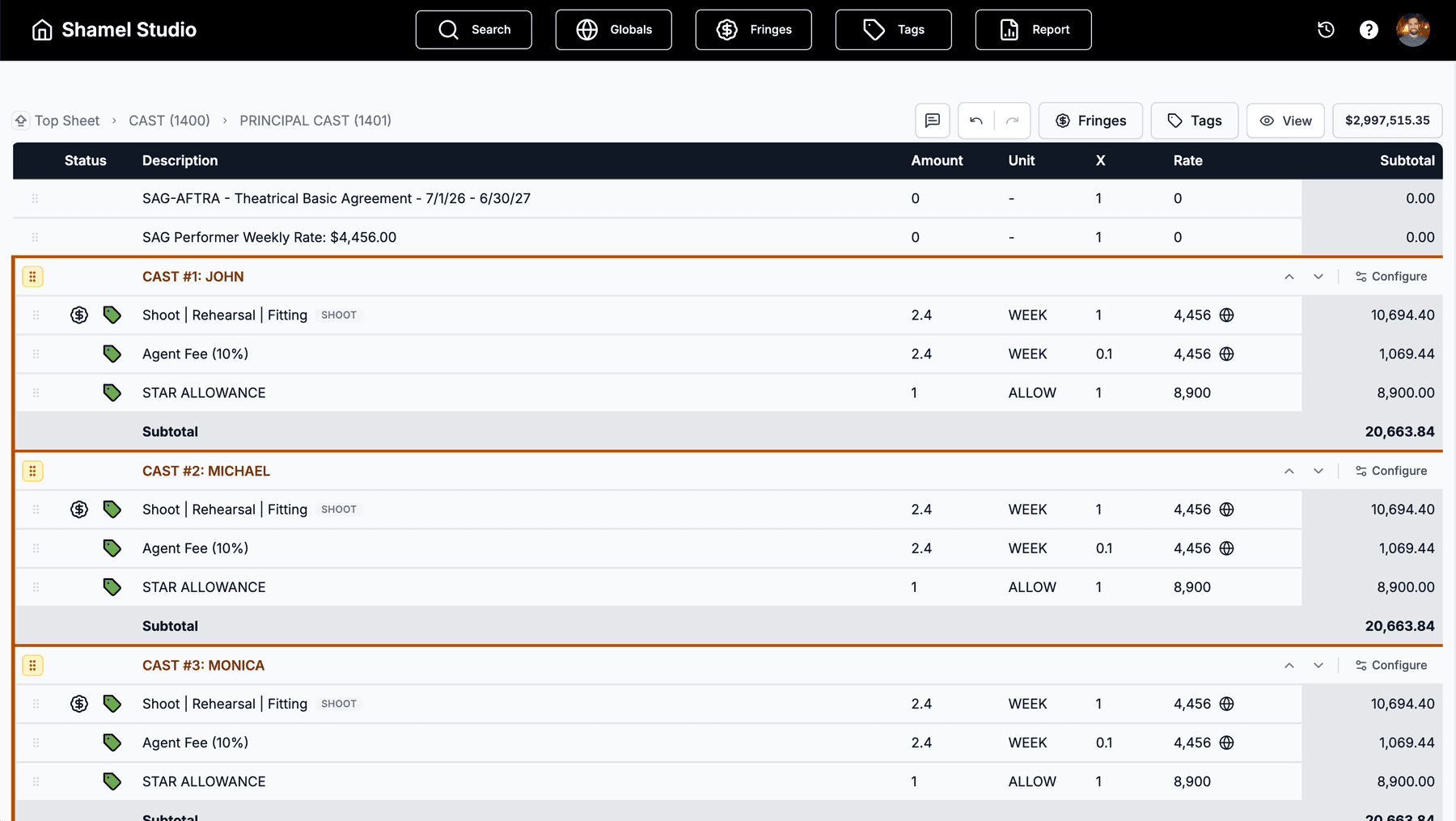
The cast allowance is your money for a known actor. A recognizable actor, often called a "name," can help you raise financing and sell the film, but they usually cost more than scale. After every other line is budgeted, whatever is left goes into a cast allowance: $67,500 at $600K, $115,000 at $1.5M, and $175,000 at $5M. If a known actor matters for your financing, this line tells you whether you can afford one, and every other line you trim adds to it.
Step 3: Factor in Union Rates and Fringes
This is where the three budgets differ most. Each size has different unions, different agreements, and different things to take care of.
At $600K: one union
SAG-AFTRA's Moderate Low Budget Agreement covers the cast: $449 a day or $1,560 a week, plus 22% pension and health. Everyone else is non-union.
What to take care of:
- Sign with SAG-AFTRA early. Becoming a signatory takes paperwork and a security deposit, so start weeks before the shoot. Our SAG-AFTRA rates guide walks through it.
- Background actors aren't covered by this agreement, so the budget uses five non-union background performers a day.
- Non-union doesn't mean no rules. California law requires overtime after 8 hours a day and double time after 12, so a 12-hour day costs 14 hours of pay. You still owe payroll taxes and workers' comp, which is why using a payroll company is worth it.
- Fringes are mostly payroll taxes: $51,244 in this budget.
At $1.5M: union crew, on low-budget terms
Every union offers reduced rates at this size, but each agreement has its own rules:
- SAG-AFTRA Low Budget Agreement: $834 a day or $2,896 a week. Background actors are now covered, at $231 a day. The film needs a theatrical release and a running time of at least 80 minutes.
- IATSE crew, Ultra-Low tier: pay is negotiated, but must meet the agreement's minimum rates. The budget uses $25.79 to $34.32 an hour, with a key grip at $31.20.
- DGA Low Budget Level 2 for the UPM and assistant directors: the UPM earns $3,599 a week and the 1st AD $3,422.
- Teamsters low-budget rates for the location manager and driver.
What to take care of:
- Union benefits are paid per person per day. IATSE pension and health is $154 a day for each crew member, whatever their hourly rate. On a key grip's day, that's more than a third of their pay. Add vacation and holiday pay, and IATSE fringes come close to two-thirds of wages.
- That's why fringes jump from $51,244 at $600K to $290,836 here. Budget them line by line, never as one flat percentage.
- Ask each union what your tier requires beyond the rate. At DGA Level 2, that includes a wrap supervision allowance and completion-of-assignment pay, each at 50% of the Basic Agreement rate. Neither is in this sample budget, so add them to yours.
At $5M: full rates and a set crew scale
- SAG-AFTRA Basic Agreement: $1,283 a day or $4,456 a week, the full union rate.
- WGA high-budget minimums for the writer, plus WGA pension and health.
- DGA Low Budget Level 4A for the director, UPM and assistant directors: the UPM earns $5,038 a week and the 1st AD $4,790.
- IATSE Tier 1A: a set wage scale for each job, the same in every state. The budget uses $28.58 to $39.00 an hour, with a key grip at $35.45.
What to take care of:
- Scale is now the floor for everyone. You can't negotiate crew rates below the Tier 1A scale, so savings have to come from the schedule and crew size.
- More guild paperwork. Writer, director and cast are all under guild contracts with their own payment, credit and residual rules. Budget time for a production lawyer to handle them.
- The DGA's wrap supervision allowance applies at Level 4A too, at 50% of the Basic Agreement rate. It isn't in this sample budget.
- Fringes reach $929,751, spread across five unions and the non-union crew.
Step 4: Estimate Day-to-Day Production Costs
Production is most of every budget. As the budget grows, it's not that everything costs more: you hire more people, and you add departments.
| Item | $600K | $1.5M | $5M |
|---|---|---|---|
| Production office | 6: UPM, 2 ADs, script supervisor, 2 PAs | 11: adds an accountant, a coordinator, a 2nd 2nd AD and 2 more PAs | 16 |
| Camera package (per week) | $2,750 | $2,750 | $5,600 |
| Lighting package (per week) | $2,100 | $2,750 | $4,400 |
| Location rentals (per day) | $1,300 | $2,000 | $5,900 |
| Permits (total) | $2,100 | $3,250 | $7,800 |
| People fed each day, at $35 a head | 32 | 50 | 83 |
What to watch for:
- At $600K, most departments are one or two people: one wardrobe person, one makeup and hair artist, a driver. Plan the schedule so no one person becomes the bottleneck.
- At $1.5M, the production office adds an accountant and a coordinator. Use them: tracking costs daily is how you protect the contingency.
- At $5M, new departments appear, such as set construction and a full transportation team, and the camera department adds operators. Locations become one of the largest costs, so lock them early.
Contingency is 5% of costs at $600K and 7.5% at $1.5M and $5M. Financiers and completion guarantors often expect 10%, so check what yours require.
Step 5: Include Post-Production
| Item | $600K | $1.5M | $5M |
|---|---|---|---|
| Editor | 11 weeks | 15.6 weeks | 21.8 weeks, with an assistant |
| Sound package | $10,500 | $20,000 | $49,500 |
| Color | $7,450 | $16,000 | $38,000 |
| Score and music licensing | $6,500 | $20,000 | $80,500 |
| Visual effects | $1,000 | $10,000 | $25,500 |
| Deliverables | $2,550 | $3,000 | $8,600 |
What to watch for:
- At $600K, music and VFX budgets are small. Write around effects you can't afford, and look at library music or a composer who'll work for a modest fee.
- At every size, get a distributor's delivery list early. Deliverables are a small line, but a missing format can delay a sale.
- At $5M, music becomes a real line item. Licensing a known song can cost more than the whole $600K music budget, so clear songs before you lock picture.
Step 6: Don't Forget Insurance and Legal
| Item | $600K | $1.5M | $5M |
|---|---|---|---|
| Insurance | $13,550 | $23,750 | $55,000 production package + $9,000 E&O |
| Completion bond | None | None | $100,000 |
| Legal and general expenses | $17,650 | $23,400 | $38,400 |
What to watch for:
- At every size, you need production insurance before you can rent equipment or shoot at most locations. Distributors will require E&O insurance before release.
- At $5M, financiers usually require a completion bond, a guarantee that the film will be finished on budget. The bond company will review your budget and schedule closely, which is another reason to get them right.
Step 7: Review, Revise, and Lock the Budget
Once locked, the budget becomes the plan you track spending against. How you track it changes with size:
- At $600K, there's no accountant on the crew, so the producer or UPM tracks costs. Keep it simple: compare spending to the budget at the end of every shoot day.
- At $1.5M, the production accountant produces cost reports that compare actual spending to the budget, usually weekly.
- At $5M, financiers and the completion guarantor expect regular cost reports, and they'll ask questions when lines run over.
Where You Shoot: What to Check
These budgets assume California. Moving the same budget to another state changes it, sometimes by a lot. Set in Georgia, the same $1.5M shoot leaves more than twice as much money for cast as in California. Before you choose a state, check:
- Crew rates and availability. Rates for negotiated and non-union crew vary by state. If the local crew base is small, you may need to bring people in and pay travel and housing.
- Minimum wage and overtime law. Some cities set their own minimum wage, and some states require daily overtime.
- Payroll taxes and workers' comp. State unemployment tax and workers' comp rates differ, and some states add other employer taxes.
- Union benefits. IATSE pension and health is lower outside Los Angeles and other production cities.
- Tax incentives. Many states return part of what you spend there, but programs have minimum spends, caps, and rules about which costs qualify, and payment can come months after you wrap. Our guide to film tax incentives explains how to evaluate a program, and the film tax incentives tool lists each state's rates, caps, and minimum spend.
- Locations, permits and weather. Permit costs and rules vary by city, and weather and daylight affect how many hours you can shoot each day.
The Three Top Sheets
For reference, here are the three full top sheets side by side. Each total includes its fringes.
| Acct | Account | $600K | $1.5M | $5M |
|---|---|---|---|---|
| 1100 | Story & screenplay | $18,000 | $45,000 | $209,587 |
| 1200 | Producers | $18,000 | $45,000 | $300,000 |
| 1300 | Director | $18,000 | $45,000 | $332,570 |
| 1400 | Cast | $98,937 | $220,664 | $587,125 |
| 1500 | Stunts | $1,855 | $1,855 | $7,420 |
| 1600 | Above-the-line travel | – | – | $37,400 |
| Total above the line | $154,792 | $357,519 | $1,474,102 | |
| 2000 | Background talent | $14,267 | $59,886 | $172,756 |
| 2100 | Production staff | $59,733 | $200,813 | $513,936 |
| 2200 | Art department | $21,023 | $44,813 | $135,368 |
| 2300 | Set dressing | $9,528 | $39,727 | $141,015 |
| 2400 | Props | $13,689 | $27,858 | $82,897 |
| 2500 | Set construction | – | – | $110,046 |
| 2600 | Camera | $37,380 | $70,104 | $160,491 |
| 2700 | Lighting | $23,489 | $51,014 | $117,840 |
| 2800 | Grip & set operations | $25,319 | $77,086 | $183,841 |
| 2900 | Production sound | $20,723 | $32,570 | $72,246 |
| 3000 | Wardrobe | $17,037 | $40,096 | $132,834 |
| 3100 | Makeup & hair | $10,444 | $44,798 | $83,922 |
| 3300 | Transportation | $14,375 | $29,770 | $229,001 |
| 3400 | Locations & catering | $54,361 | $135,441 | $422,889 |
| Total production | $321,369 | $853,976 | $2,559,083 | |
| 4000 | Editorial | $33,710 | $60,643 | $188,075 |
| 4100 | Score & music | $6,500 | $20,000 | $80,500 |
| 4200 | Visual effects | $1,000 | $10,000 | $25,500 |
| 4300 | Post sound | $10,500 | $20,000 | $49,500 |
| 4400 | Color, titles & deliverables | $10,250 | $21,500 | $51,000 |
| Total post-production | $61,960 | $132,143 | $394,575 | |
| 5000 | Publicity & festivals | $1,900 | $5,500 | $19,500 |
| 5100 | Insurance (and completion bond at $5M) | $13,550 | $23,750 | $164,000 |
| 5200 | Legal & general expenses | $17,650 | $23,400 | $38,400 |
| Total other costs | $33,100 | $52,650 | $221,900 | |
| Contingency | $28,561 | $104,722 | $348,725 | |
| Grand total | $599,782 | $1,501,009 | $4,998,385 | |
| Fringes included above | $51,244 | $290,836 | $929,751 | |
Want to see how your own film compares?
Shamel Studio builds a first-draft budget like these from your budget size and location, with current union rates and fringes applied, and lets you adjust every line.
Frequently Asked Questions
What does a $600,000 film budget cover?
In our California sample, $600,000 covers 15 shoot days, a non-union crew of 23, five principal actors and six day players under SAG-AFTRA’s Moderate Low Budget Agreement, and 8 weeks of post, with $67,500 left over for cast, such as a known actor. The key is a short, tightly planned schedule with few locations.
Can I hire SAG-AFTRA actors with a non-union crew?
Yes. SAG-AFTRA’s agreements cover performers only, so you can sign with SAG-AFTRA and hire a non-union crew. That’s how our $600K sample is built.
What changes when a film budget goes from $600,000 to $1.5 million?
The crew, assistant directors and drivers go union, on low-budget terms. Union pension and health, paid per person per day, is the biggest new cost: in our samples, fringes grow from $51,244 to $290,836. Background actors are covered by SAG-AFTRA, and the film needs a theatrical release.
What changes at $5 million?
Cast move to SAG-AFTRA’s full rates ($1,283 a day), a WGA writer is paid at high-budget minimums, and IATSE crew are paid from a set wage scale instead of negotiated rates. Financiers usually require a completion bond, and the crew grows to about 70 people.
Which union agreements apply at $600K, $1.5M and $5M?
At $600K, SAG-AFTRA’s Moderate Low Budget Agreement covers the cast, and everyone else can be non-union. At $1.5M, cast work under SAG-AFTRA’s Low Budget Agreement, the UPM and ADs under DGA Low Budget Level 2, crew under IATSE’s Ultra-Low tier, and drivers under Teamsters low-budget terms. At $5M, cast work under SAG-AFTRA’s Basic Agreement, the director and ADs under DGA Low Budget Level 4A, crew under IATSE Tier 1A, and a WGA writer at high-budget minimums.